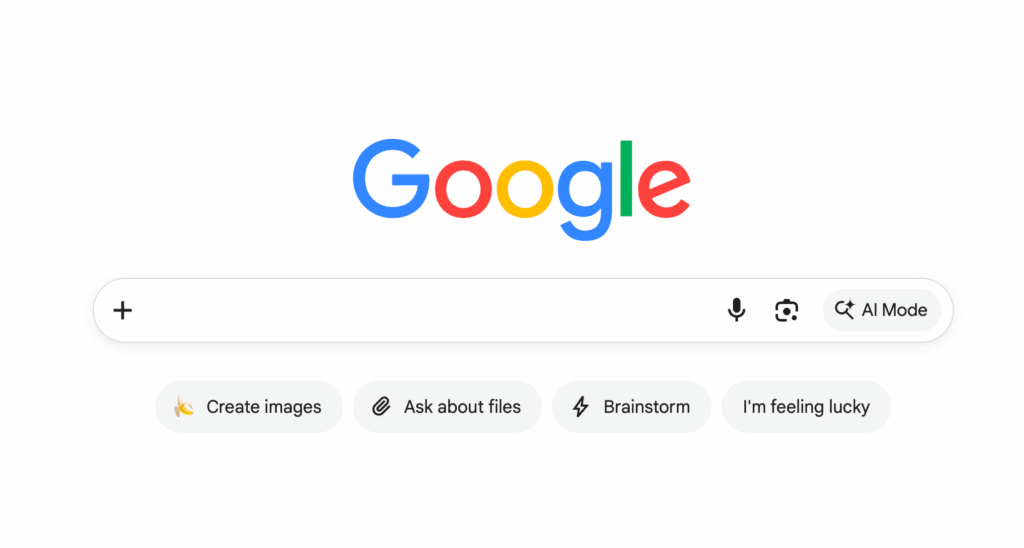
Since becoming available to the public in 1998, going to Google has been largely the same experience. The homepage is notoriously simple, with a search box, two buttons, and the Google logo. You type what you want, hit the “Search” button, and get a list of links in turn. It’s such a ubiquitous experience that “Google it” has become a verb, and so trusted that billions of people, from the computer-savvy to the technologically-challenged, use it the same way every day without thinking twice.
But that homepage appears to be changing, and this can have big implications for businesses that depend on being found through online searches on the platform.
What Exactly Is Google Doing?
Google is testing a new version of its homepage that replaces the classic Search button with three new shortcuts: Create images, Ask about files, and Brainstorm. Placing them below the search box, it also has an “AI Mode” button inside the search box itself. The “I’m Feeling Lucky” button, around since 1998, is still on the page, but the Search button itself is nowhere on this new design.
Google’s VP of Product Robby Stein has confirmed this is a test and describes it as “a small test on desktop to help people find new things they can do with Search,” clarifying that typing a search query and hitting enter still works exactly as it always has.
Google is carefully saying that search is not going away. They’re saying they’re testing this change because they want people to discover AI features. But the way they’re introducing something new on a product this widely used is a pretty big signal about where things are going.
This Isn’t Just About the Search Button
The Google homepage is not just a “web page” in the normal scheme of things. Google has called this the biggest upgrade to the Search box in more than 25 years, and it is a massive thing. Changing it, even if just in a test, is not a small or casual decision.
Google is trying to move users from the familiar behavior of typing a search query and reading a list of results toward something very different. They’re trying to create a conversational AI experience that synthesizes answers rather than pointing you directly to websites. This shift is already very measurable. The proportion of Google searches that display AI-generated summaries increased from just over 15 percent to more than 40 percent within a single year, and monthly visits to Google’s AI Mode more than doubled between June 2025 and May 2026.
That’s a big behavioral change, and it’s happening fast.
What Exactly is AI Mode?
The traditional Google Search returns a list of links. You click the one that calls to you, visit a website, and see if it has what you need. AI Mode works differently. It performs multiple related searches simultaneously, then brings those results together and provides a synthesized response. The user gets an answer from AI rather than a list of options to explore to look for that answer.
For some queries this is useful. Comparing products, researching complex topics, or getting a quick explanation. AI Mode handles all these in ways that save users’ time.
But for businesses that depend on people clicking through to their websites, this is not a comforting development. If a user asks a question and gets a complete answer without ever visiting a site, that’s traffic that never shows up on their website. Increasing zero-click searches with AI-powered results reduces website traffic, and in a sense steals that traffic by providing answers it got from the websites that are losing it. This is a real and growing dynamic, and this new homepage design pushes it further along.
What AI Mode Means for SEO
The rules of search have always rewarded businesses that give Google what it wants, which is relevant, well-structured, trustworthy content. That’s still true, but the definition of what Google wants has been shifting.
Pages that demonstrate real-world knowledge, proven subject matter expertise, strong brand reputation, and trustworthy sourcing are more likely to appear in these AI-based results. This connects directly to EEAT, which we wrote about recently. In this new AI environment, the signals that prove your content is credible within that framework matter more than ever.
What’s changing is not EEAT, it’s how results are being delivered. Your content might still be the source Google draws from when it generates an AI answer, but the user may never see your website. They’ll see your answer, but the link to your site will just be one of several citations beneath it.
This is why content quality and genuine expertise matter more in this environment than ever before. Generic content that could have been written by anyone is not likely to be a source Google cites. Content that reflects real experience, real knowledge, and a real perspective on your specific field is likely to earn that citation.
AI vs. UX
Here’s an angle that doesn’t get discussed enough. Google is changing their interface. Billions of users have muscle memory for this interface, essentially in place for almost 30 years, and nudging them toward a product many of them are skeptical about may not sit well.
Public sentiment toward AI tools is genuinely mixed and seems to be trending downward. Many users have concerns about AI-generated answers being accurate, about losing the ability to evaluate sources for themselves, and just a general sense that AI is being pushed on them whether or not they want it. Google is making a big bet that their brand authority will make users look past their skepticism when AI is the first thing they see on a homepage that used to be about search results.
It may work. Google has one of the world’s strongest brands. But moving a legacy platform with billions of daily, trusting users toward an AI-first experience that they may not trust is no small thing. How users respond should matter a great deal to Google.
What Should You Do?
It’s hard to know exactly how all this will play out. Google says they’re just testing, not announcing a permanent change. The pace of how search is changing is rapid and not really all that predictable.
What is predictable is this: the businesses that will do best in an AI-first search environment are the ones that are doing what good SEO already requires. Real content written by real people who know their subject well, specific and useful information that answers real questions, and a trustworthy digital presence with good reviews, accurate business information, and genuine credibility.
The move into the EEAT framework we wrote about recently is not a mere coincidence. It’s Google’s way of signaling that as AI increasingly starts to generate answers from web content, they intend to favor sources that demonstrably know what they’re talking about.
The Google homepage is changing. The fundamentals of what makes a business easy to find are not.
At Wild Iris Marketing, we can help you build a digital presence that is genuinely credible, not just technically optimized. If you’re watching these changes and wondering what they mean for your marketing strategy, let’s talk about it!