Take a look at these two Facebook ads.
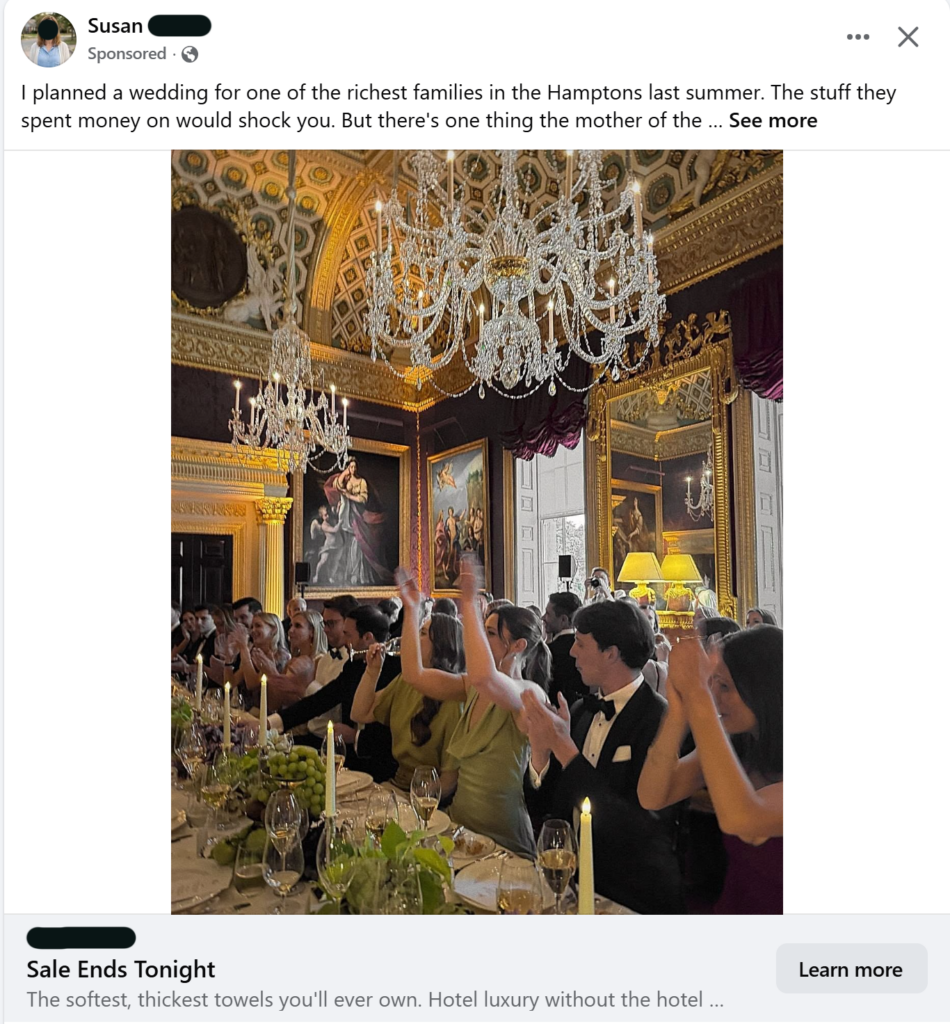
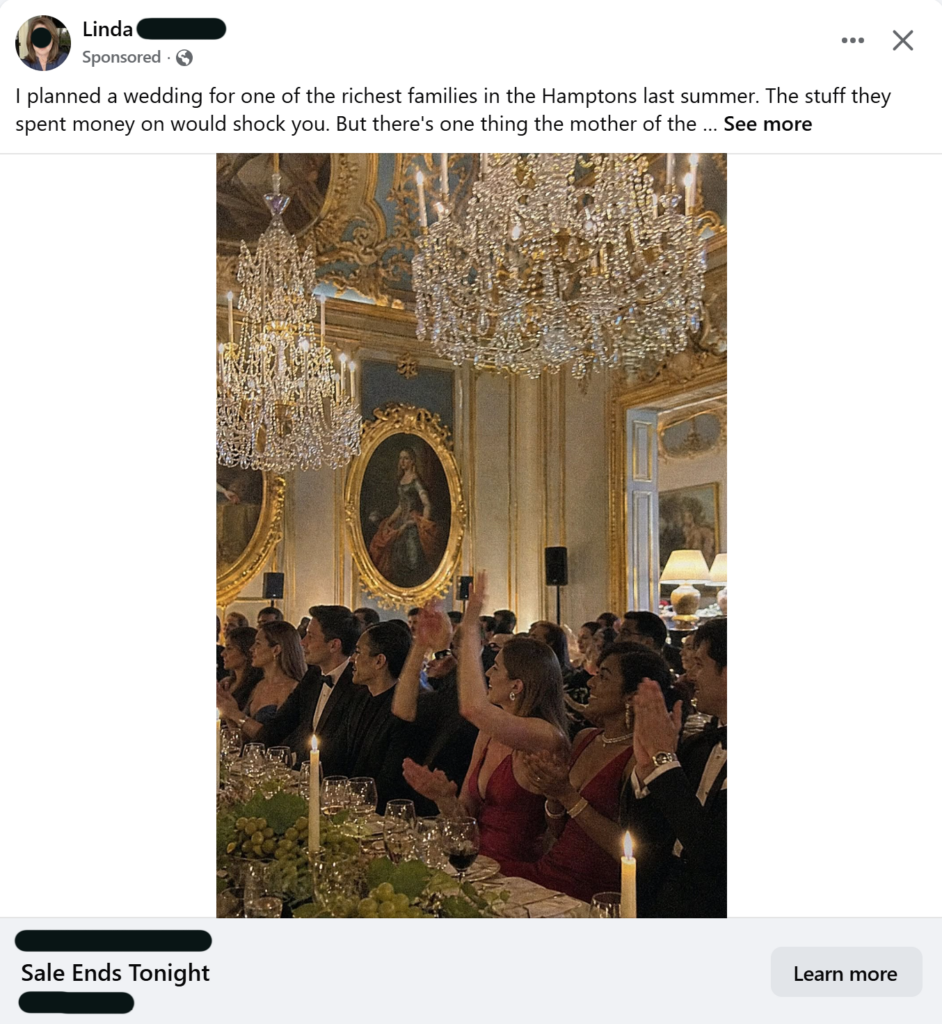
They have the same opening line, the same story about planning a wedding for a wealthy family from the Hamptons, and the exact same call to action, all posted under two different names pointing to two different companies. The photos are nearly identical as well, both showing a lavish formal dinner with crystal chandeliers, candlelight, and guests in black tie. If you look closely, you can spot the differences. The background details shift slightly, and a man in a tuxedo on the right edge of the frame appears fully in one photo and is barely visible in the other. The images were almost certainly generated separately from the same AI prompt and based on the same uploaded image.
This is AI-generated marketing at its most obvious, and most people scroll past it without consciously registering what they’re seeing. But something registers anyway, a vague sense that this isn’t quite real, that nobody actually wrote this, least of all the person whose name is on the ad. That feeling of insincerity costs businesses more than they realize.
The AI Duplicate
The ads above are an extreme and particularly obvious example, but they illustrate something happening all over digital marketing right now. AI tools make it incredibly easy to generate content in large volume. Give an AI a prompt, wait thirty seconds, and you have a Facebook post with words and an image ready to go. Do that a thousand times across a thousand accounts and you have a content farm that looks at a glance like a thousand different businesses talking to their audiences. Nobody is really talking to anybody, though. The content exists to generate clicks, and audiences can feel the difference, even if they can’t explain exactly why.
The wedding planner story in these ads is designed to feel personal and intriguing. It reads as though it were a genuine first-person account. But this identical text appears under two different names, paired with two slightly different AI-generated ballroom photos, and this gives it away completely. The authenticity isn’t there and anyone can see it if they’re paying attention.
Canned Content
Facebook ads of this sort are easy to spot once you know what they look like. Canned content, whether written by AI or a corporate marketer, takes a bit more attention to see, and it affects a lot of businesses. These aren’t businesses trying to deceive people, they’re just using what seems to be a great way to save time.
How exactly does canned content work? A big marketing company or a corporate parent company creates a library of social media posts, newsletter templates, and blog content. Individual businesses subscribe to or access this service and push that content out under their own name on a schedule. The content is relatively well-written, it looks okay, and it covers relevant topics.
We see this pattern a lot in industries with compliance and regulations. For example, real estate agents, insurance agencies, medical offices etc. A national brokerage or marketing vendor creates this content for their industry, and the individuals distribute it because it’s easy and they feel like they’re actively doing marketing work. The corporation benefits because its brand gets exposure and its messaging gets distributed. But the individual offices, agents or brokers get almost nothing out of it, because there’s nothing in the content that differentiates them from others in their industry. They may even be sending the same newsletter or social media content out to people who have seen the exact same content with a different headshot from someone else the same day or week. If anything, this can COST you clients because you come across as generic, inauthentic or “just like everyone else”.
Real estate is built on personal relationships and local expertise. A buyer choosing an agent is choosing a person. A newsletter that could have come from any agent in any market isn’t helping that person stand out or build the kind of trust that will lead to a listing or a contract.
Insurance agents, financial advisors, franchise restaurants, and home service companies all run into this. Any situation where a national entity produces content and individual operators distribute it without adding anything of their own will have the same underlying problem.
Authentic Content
Authentic content builds a real relationship between a specific person or business and the audience they’re trying to reach, and canned content just isn’t able to do that.
When a home services company writes a newsletter about what they’re seeing in their local market right now, what issues their possible clients might be dealing with such as a recent hail storm or wildfire, or what might be coming their way (a super El Niño), it shows them as a company with genuine local knowledge and gives their audience a reason to think of them when they’re ready to make a move.
When a local business posts social media content that reflects their real work, their unique voice, and their actual perspective on what’s happening in their industry, it creates a building impression of a real person being behind the brand. That impression builds over time and it’s one that you just can’t replicate with a content subscription that lots of other locals are also using.
The AI-generated wedding planner ads shown above and other canned content like the newsletters we’ve talked about produce the same result. They are repetitive content that fills space but doesn’t say anything real, and because of that doesn’t make any genuine connection between a business and the people it’s trying to serve.
Is Your Content Canned?
Are you getting your content from an AI farm? If your social media posts look like they have been written by someone who’s never met you and doesn’t know anything about your business, your social media content looks like everybody else’s, and your newsletter doesn’t say anything based on your specific experience, your specific market, and your relationship with your audience, then your content isn’t doing its job.
Your content needs to be working as hard for you as you do for your customers.
Let’s Be Real
Content that could come from anyone and is used by everyone does the work of no one. Businesses that build real audiences, genuine trust, and top-of-mind awareness show up as themselves. They speak with a real voice, give a real perspective, and have real things to say about the work they do.
At Wild Iris Marketing, every piece of content we write for a client is specific to that client. We learn their voice, their market, their differentiators, and their audience, and we write from that knowledge. If your current content could just as easily have come from your competitor, that’s a real problem, and we’re here to help.